
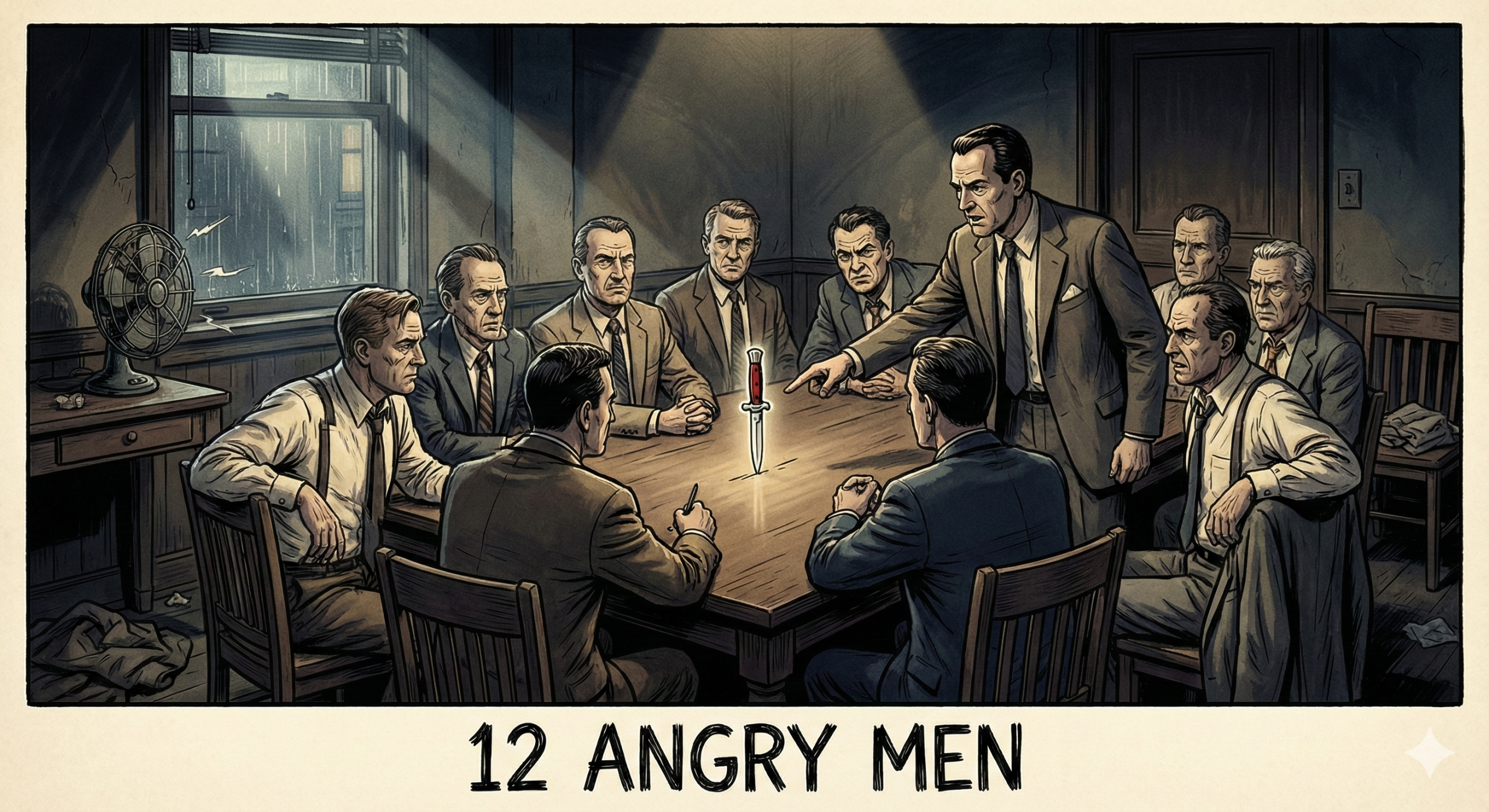
12 Angry Men
12 Angry Men takes place entirely in one room over the course of one sweltering afternoon. Twelve jurors must decide the fate of an 18-year-old boy from a slum, accused of murdering his father with a switchblade knife. If convicted, he faces the death penalty. The case seems open-and-shut: two eyewitnesses, a clear motive (years of abuse), and a purchased murder weapon. An initial vote shows 11 jurors ready to convict and go home. Only Juror 8 votes "not guilty"—not because he's certain of innocence, but because he believes a boy's life deserves more than 15 minutes of discussion. This single vote of conscience triggers a deep deliberation that gradually exposes reasonable doubt. Through patient questioning and reconstructing evidence, Juror 8 reveals assumptions, biases, and logical gaps. One by one, jurors reconsider their positions. The film's genius lies in its exploration of how personal baggage infects judgment. Juror 3, who most vehemently demands conviction, eventually reveals he's estranged from his own son—he's not judging the defendant but punishing his own child by proxy. Juror 10's racism surfaces in a shocking monologue that causes other jurors to turn their backs in disgust. These moments expose that integrity requires self-awareness: we cannot judge fairly when unexamined biases control us. The deliberation becomes a masterclass in persuasion and leadership. Juror 8 never bullies or shames. When Juror 3 produces a supposedly "unique" switchblade knife identical to the murder weapon, Juror 8 responds by producing an identical knife he purchased in the defendant's neighborhood—demonstrating that evidence can be questioned without attacking those who believe it. When facts change jurors' minds, he acknowledges their courage in changing positions rather than claiming victory. The film's climax comes when only Juror 3 holds out. Surrounded by eleven jurors who've reconsidered, he delivers an emotional breakdown about his son, finally admitting his judgment has been corrupted by personal pain. When he finally votes "not guilty," it's not surrender—it's liberation from bitterness that was destroying his integrity.
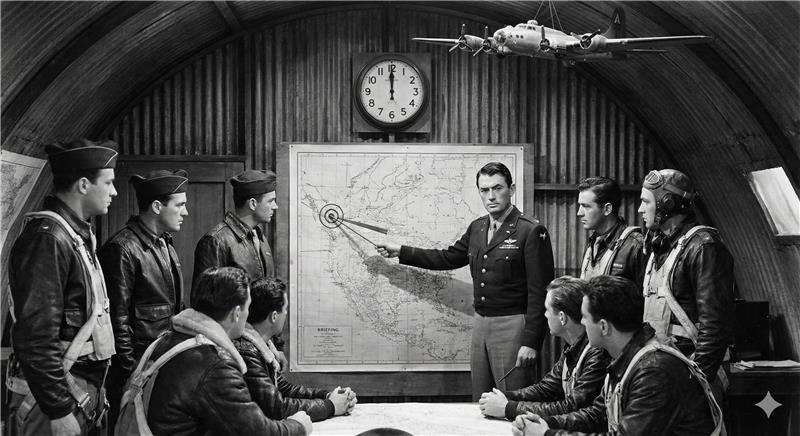
12 O’clock High
12 O'Clock High is set in England, 1942, during World War II's early years when the U.S. Army Air Forces conducted daylight bombing raids over Nazi-occupied Europe. These missions had catastrophic casualty rates—some groups lost 25-30% of crews per mission. The film focuses on the 918th Bombardment Group, which has become "hard luck" after months of losses, failed missions, and accumulated trauma. The story is told in flashback by Major Harvey Stovall, who returns to the abandoned airbase years after the war. Finding a commemorative toby jug (beer mug) triggers memories of the unit's transformation under General Frank Savage. When we first meet the 918th, it's commanded by Colonel Keith Davenport, a compassionate leader deeply loved by his men. Davenport cares profoundly about his crews—he knows their names, visits the wounded in hospitals, and grieves every loss personally. However, this emotional investment has backfired: pilots exploit his compassion by requesting transfers for minor ailments (seeing Davenport as a "soft touch"), morale is terrible despite his kindness, and mission performance is the worst in the division. The group has earned the nickname "hard luck" not because of bad luck but because they've internalized failure as identity. General Pritchard, recognizing that compassion without accountability enables dysfunction, relieves Davenport and appoints Brigadier General Frank Savage as the new commander. Savage is Davenport's opposite: cold, demanding, seemingly indifferent to personal feelings. His first acts shock the unit: he restricts transfers (nobody leaves), grounds all officers he deems incompetent regardless of seniority, and announces maximum effort missions with brutal honesty about expected casualties. The group despises Savage. They call him a "hard-nose," resent his coldness, and compare him unfavorably to the beloved Davenport. Lieutenant Colonel Ben Gately, Davenport's closest friend, actively undermines Savage's authority. The unit's poor performance continues initially because resentment prevents them from responding to Savage's demands.

Apollo 13
Apollo 13 tells the true story of NASA's April 1970 mission that became "a successful failure"—the crew survived a catastrophic explosion that destroyed their spacecraft's life support systems, requiring improvised solutions to bring them home alive. The mission begins routinely: Apollo 13 is NASA's third planned moon landing, following successful Apollo 11 and 12 missions. Commander Jim Lovell is a veteran astronaut; this is his fourth space flight and second trip to the moon. Just days before launch, Ken Mattingly is grounded due to potential measles exposure (he never develops measles). Jack Swigert, the backup pilot with minimal training with this specific crew, replaces him—creating immediate team cohesion concerns. The flight proceeds normally for two days. Then, 200,000 miles from Earth, astronauts perform a routine "cryo stir" of oxygen tanks. An explosion rips through the Service Module, caused by damaged wiring that sparked a fire in a pure oxygen environment. The crew hears a bang, feels the spacecraft shudder, and watches oxygen venting into space. Swigert's famous understatement: "Houston, we've had a problem." Ground control quickly realizes the crisis's severity: The Service Module—containing oxygen, water, electricity, and propulsion—is dying. The Command Module, where astronauts normally live and which contains heat shields for reentry, is connected to the damaged Service Module. If they stay in the Command Module, they'll run out of oxygen before reaching Earth. The Lunar Module (LEM), designed to land two men on the moon for 45 hours, must now serve as a lifeboat for three men for four days—it lacks sufficient oxygen, water, power, and carbon dioxide scrubbing capacity for this purpose.

Gladiator
Gladiator is set in 180 AD during the twilight of Rome's "Golden Age" under the philosopher-emperor Marcus Aurelius. The film opens with General Maximus leading Roman legions to victory in Germania, completing Marcus Aurelius's decades-long campaign to secure the empire's borders. Maximus is beloved by his troops, respected by the emperor, and yearns only to return home to his wife and son in Spain to farm his land. Marcus Aurelius, aging and dying, reveals to Maximus his vision: rather than passing power to his son Commodus, he wants Maximus to become temporary leader and restore the Roman Republic, ending imperial rule. Commodus, discovering this plan, murders his father and orders Maximus's execution along with his family. Maximus escapes his executioners but arrives home too late—his wife and son have been crucified and burned. Wounded and grief-stricken, Maximus collapses and is found by slave traders. He's sold to Proximo, a lanista (gladiator trainer) who runs combat shows in provincial arenas. Maximus, who once commanded legions, now fights for his life in the sand, initially numb and suicidal. He wins fights through sheer skill and rage but refuses to engage with the crowd, performing the bare minimum to survive. The turning point comes when Proximo reveals he was once a gladiator who earned his freedom from Marcus Aurelius himself. He tells Maximus: "Win the crowd, and you'll win your freedom." More importantly, Proximo challenges Maximus to find purpose beyond survival: "I wasn't the best because I killed quickly. I was the best because the crowd loved me. Win the crowd." Maximus begins to fight differently—not just to kill opponents, but to command attention. His prowess brings his troupe to Rome for games in the Colosseum, where Commodus now rules as a paranoid, unstable tyrant. When Maximus reveals his identity in the arena ("My name is Maximus Decimus Meridius, commander of the Armies of the North, General of the Felix Legions..."), he transforms from anonymous slave to living threat to Commodus's legitimacy.

Good Will Hunting
Good Will Hunting is set in Boston, primarily in South Boston ("Southie"), a working-class Irish neighborhood where Will Hunting was born and raised in foster care. Will is a 20-year-old janitor at MIT who spends his free time with his construction-worker friends, drinking beer, getting into fights, and hiding his extraordinary intellect from everyone except his closest friend, Chuckie. Will has a photographic memory and genius-level abilities in mathematics, history, chemistry, and virtually every subject. He can solve in minutes problems that take MIT professors years to crack. But he's also profoundly damaged—abandoned by his parents, cycled through abusive foster homes, beaten regularly, and burned with cigarettes by one foster father. These traumas created defensive walls: Will pushes away anyone who gets close, sabotages opportunities for advancement, and uses his intellect as a weapon to keep people at distance through sarcasm and superiority. The story begins when Professor Gerald Lambeau, a Fields Medal-winning mathematician, posts a difficult proof on a hallway blackboard as a challenge for his graduate students. Weeks pass with no solution. Then one night, Will (working as a janitor) solves it anonymously. Lambeau posts a harder problem; Will solves that too. When Lambeau catches Will, he's astonished—here's a once-in-a-generation mathematical mind working as a janitor with no formal education beyond high school. Lambeau tries to mentor Will, but Will's defensive hostility makes it impossible. When Will assaults someone and faces jail time, Lambeau makes a deal: Will will avoid prison if he agrees to study mathematics with Lambeau and attend therapy to address his behavioral issues. Will agrees to the former but sabotages multiple therapists with psychological manipulation—he's brilliant at identifying their insecurities and exploiting them. Desperate, Lambeau turns to his college roommate, Sean Maguire, a psychology professor at Bunker Hill Community College. Sean and Lambeau were both prodigies but took radically different paths: Lambeau pursued academic glory; Sean chose to teach at a community college and care for his terminally ill wife (who died two years before the film begins). Their reunion is tense—Lambeau views Sean's choices as wasted potential; Sean views Lambeau as emotionally stunted.
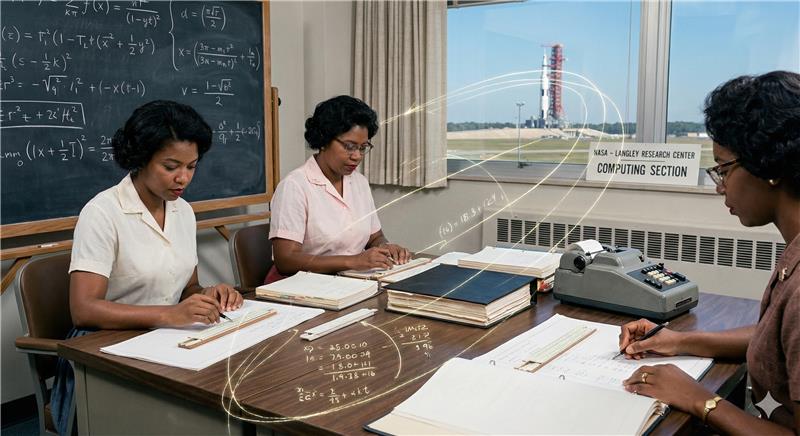
HIdden Figures
Hidden Figures tells the true story of three Black women mathematicians who were essential to NASA's early space program during the Space Race of the 1960s. Set between 1961-1962, the film captures a pivotal moment when America competed with the Soviet Union for space supremacy while Black Americans fought for civil rights at home. Katherine Johnson, Dorothy Vaughan, and Mary Jackson work in the segregated "West Area Computers" division at NASA's Langley Research Center in Hampton, Virginia. Despite their exceptional mathematical abilities, they face daily indignities: separate bathrooms marked "Colored," separate coffee pots, exclusion from meetings, and no credit for their contributions. They're paid less than white colleagues doing similar work and passed over for promotions despite superior performance. Katherine's storyline begins when she's temporarily assigned to the Space Task Group to calculate launch windows and orbital trajectories for astronaut John Glenn's mission—the first American to orbit Earth. She enters a room of white male engineers who immediately question her presence. They refuse to share information, give her menial tasks, and speak as if she's invisible. The most visceral representation of discrimination comes through Katherine's bathroom situation: the nearest "colored ladies room" is half a mile away. She disappears for 40 minutes multiple times daily, running in heels while carrying folders, compromising her productivity and health. Dorothy Vaughan's arc demonstrates proactive resilience. Recognizing that IBM computers will make human "computers" obsolete, she sneaks into the library's whites-only section to borrow a FORTRAN programming book. When security stops her, she calmly asserts her rights as a taxpayer and refuses to leave. She then teaches herself and her entire team programming, positioning them as indispensable when the IBM 7090 arrives. Despite performing all duties of a supervisor, NASA refuses to officially promote her—until the IBM breaks and she's the only person who can fix it. Mary Jackson's story focuses on structural barriers to advancement. She wants to become NASA's first Black female engineer but needs night classes at an all-white high school to qualify. Virginia law prohibits integration, forcing her to petition a judge for an exception. Her argument—"I have no choice but to be the first"—captures the impossible burden placed on pioneers who must be extraordinary just to be treated as equal.
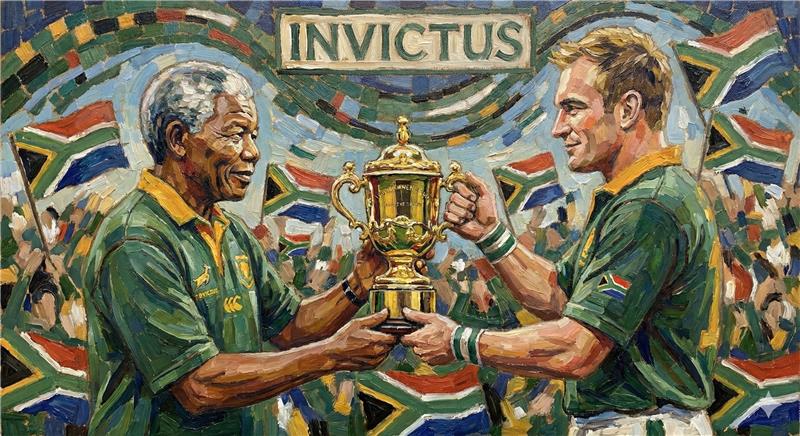
INVICTUS
Invictus is set in 1995, just one year after Nelson Mandela became South Africa's first Black president following the end of apartheid. The country teeters on the edge of chaos, decades of brutal racial segregation have left deep wounds, economic inequality, and mutual distrust between Black and white South Africans. Many in Mandela's African National Congress (ANC) party want retribution against their former oppressors. White South Africans fear losing their jobs, homes, and safety. The plot centers on Mandela's audacious strategy to unite the nation through rugby, specifically, by embracing the Springboks, a team historically associated with white Afrikaner culture and apartheid oppression. When his staff wants to change the team's name and colors, Mandela intervenes, recognizing that humiliating symbols important to white South Africans would deepen divisions rather than heal them. Mandela meets with François Pienaar, the Springboks captain, and challenges him to inspire the team to win the 1995 Rugby World Cup, which South Africa is hosting. The film follows the team's journey from underdogs to champions, paralleling Mandela's efforts to build a "rainbow nation." Key scenes include Mandela visiting Robben Island (where he was imprisoned for 18 years) with Pienaar, demonstrating forgiveness rather than bitterness, and Mandela donning the Springbok jersey, a powerful symbol of reconciliation, at the championship match. The climactic World Cup final against New Zealand's All Blacks becomes a metaphor for national unity. Black and white South Africans, who had never cheered for the same team, unite behind the Springboks. When South Africa wins, the victory represents more than sports—it embodies Mandela's vision of a nation that respects all its people. The film's title comes from the William Ernest Henley poem "Invictus" (Latin for "unconquered"), which sustained Mandela during his 27 years of imprisonment: "I am the master of my fate, I am the captain of my soul."
Lincoln
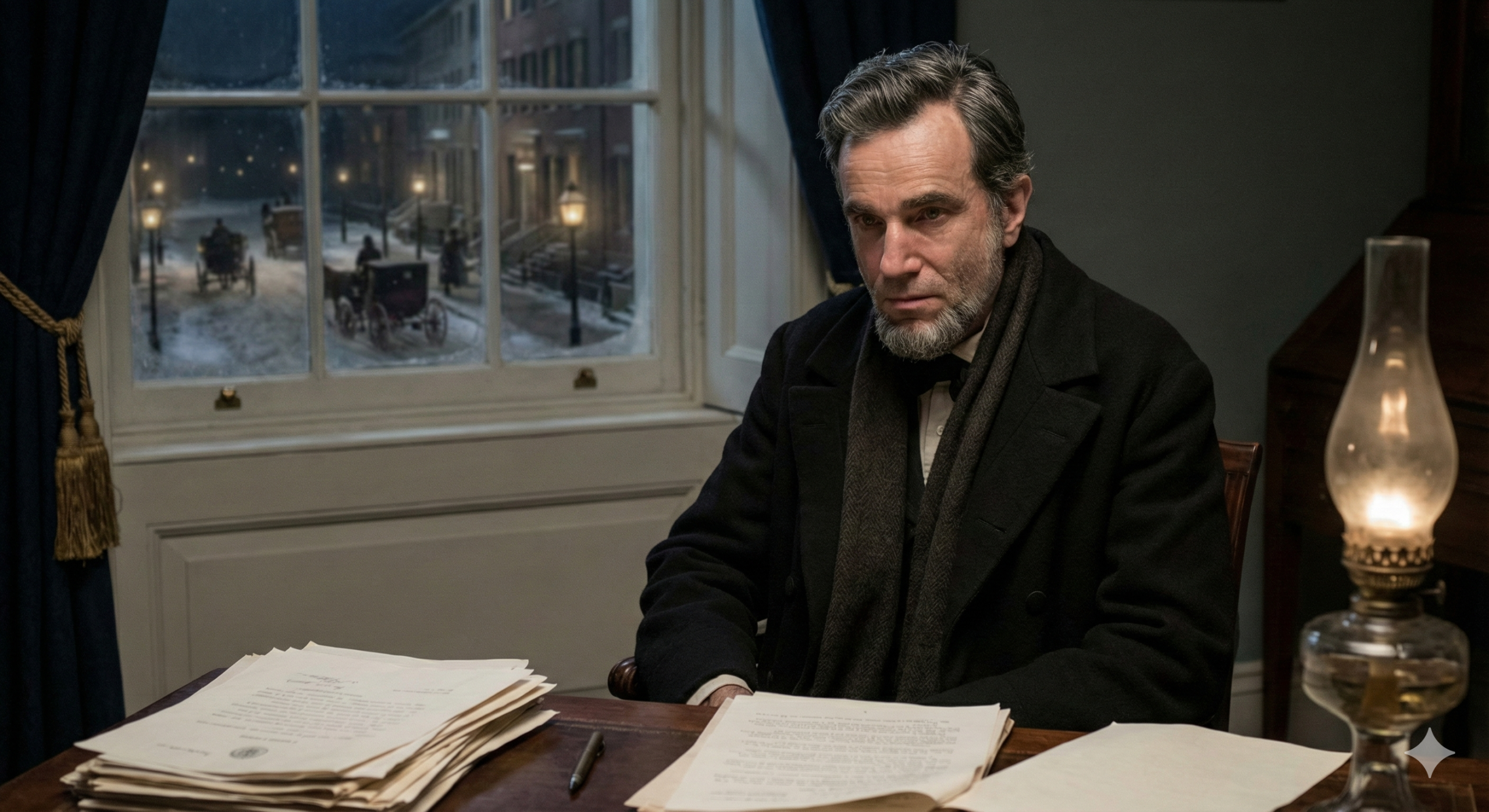
Lincoln focuses on the final four months of Abraham Lincoln's life (January-April 1865) as he fights to pass the 13th Amendment to the U.S. Constitution, which would permanently abolish slavery nationwide. The film is based on Doris Kearns Goodwin's book Team of Rivals and captures a moment when military victory in the Civil War is near but not certain, and Lincoln faces a critical choice: end the war through negotiation (which would likely preserve slavery in border states) or continue fighting until he can pass the amendment. The political situation is complex: The Emancipation Proclamation (1863) freed slaves only in Confederate states as a war measure, leaving slavery legal in loyal border states and vulnerable to future reversal. Lincoln knows that only a constitutional amendment can permanently end slavery. But passing an amendment requires a two-thirds majority in the House of Representatives, and Republicans lack sufficient votes. They need at least 20 Democrats to vote yes. The film opens with Lincoln meeting Black Union soldiers who recite the Gettysburg Address back to him, reminding him of the war's moral purpose. But he's immediately pulled into political calculation: The Radical Republicans, led by Thaddeus Stevens, want the amendment to declare full racial equality. Lincoln knows this language will fail—moderate and conservative Republicans will never support it, and Democrats will use it to rally opposition. He must convince Stevens to moderate his language, arguing for what's achievable rather than what's ideal. Lincoln faces opposition from multiple directions: Confederate peace commissioners arrive offering to negotiate war's end, which would make the amendment unnecessary and cost Republican moderates who want peace; Mary Todd Lincoln, traumatized by their son Willie's death, opposes Lincoln risking their surviving son Robert joining the army; Radical Republicans accuse Lincoln of compromising principles; Conservative Republicans fear the amendment will reignite war; and Democrats are ideologically opposed to abolition.

Money Ball
Moneyball is based on Michael Lewis's 2003 book about Billy Beane's revolutionary approach to building a competitive baseball team with one of the sport's smallest budgets. Set primarily in 2002, the film captures a moment when baseball—a sport steeped in tradition and conventional wisdom—confronted data analytics that challenged everything scouts and managers believed. Billy Beane is General Manager of the Oakland Athletics, a small-market team that cannot compete financially with giants like the New York Yankees (whose payroll is three times larger). After the 2001 season, Oakland loses its three star players to wealthier teams. The owner tells Beane: "Replace them with the limited budget you have." Conventional wisdom says this is impossible—you can't compete without elite talent, and elite talent costs money Oakland doesn't have. Beane meets Peter Brand, a young Yale economics graduate working in Cleveland's front office, who introduces him to sabermetrics—statistical analysis of baseball performance developed by Bill James. Brand's radical insight: baseball systematically misvalues players because scouts focus on traditional metrics (batting average, stolen bases, outward appearance) rather than what actually produces wins: getting on base (on-base percentage) and advancing runners. Players who get on base through walks or hit-by-pitches are undervalued because they don't look exciting, yet they're statistically as valuable as players who hit home runs. Beane hires Brand and together they build a team using this unconventional approach: ignore what players look like or how they play; buy statistics (specifically, on-base percentage and slugging percentage). They acquire players other teams consider defective: Jeremy Giambi (pudgy, doesn't run well), Scott Hatteberg (catcher who can't throw but can get on base), David Justice (aging veteran past his prime). The entire baseball world mocks them. The film follows the 2002 season as Beane's experiment unfolds. Initially, it's a disaster. The A's lose games, the manager sabotages the strategy by benching players Beane acquired, scouts openly rebel ("You're destroying baseball!"), and media ridicules the approach. Beane faces pressure to abandon his methods and return to conventional strategies. His own manager, Art Howe, refuses to cooperate—playing players in positions Beane didn't intend, protecting traditional favorites.
Norma Rae
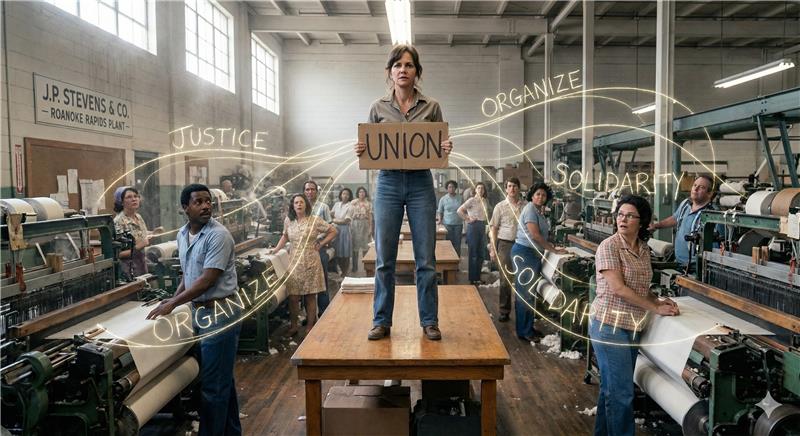
Norma Rae is based on the true story of Crystal Lee Sutton, a textile worker who helped unionize the J.P. Stevens textile mill in Roanoke Rapids, North Carolina, in the 1970s. The film captures the American South's labor struggles during an era when textile mills dominated local economies, paying poverty wages while demanding dangerous working conditions. Norma Rae is a 31-year-old widow with two children from different fathers, working in the same cotton mill where her parents have worked for decades. The job is brutal: deafening noise (causing widespread hearing loss), cotton dust creating respiratory disease ("brown lung"), 12-hour shifts, minimal breaks, poverty wages, and management that treats workers as disposable. When someone collapses from heat exhaustion, they're dragged aside and work continues. When Norma Rae's mother temporarily loses hearing from the noise, she continues working—there's no choice. Reuben Warshowsky arrives from New York, sent by the Textile Workers Union to organize the mill. He's Jewish, educated, from a different world—initially, workers distrust him as an outside agitator. He begins recruiting, and Norma Rae, sharp-minded and frustrated by workplace conditions, starts attending meetings. Reuben recognizes her leadership potential: she's respected by fellow workers, unafraid to speak up, and desperate for change. Management responds viciously: they spread anti-union and anti-Semitic propaganda, hold mandatory anti-union meetings, threaten job loss, and isolate union sympathizers. When Norma Rae refuses to stop organizing, she's fired. Her response becomes the film's iconic moment: she writes "UNION" on a piece of cardboard, stands on her work table holding the sign above her head, and refuses to move. Workers gradually stop their machines in solidarity until the factory is silent—a breathtaking act of collective courage.
Pursuit of Happyness
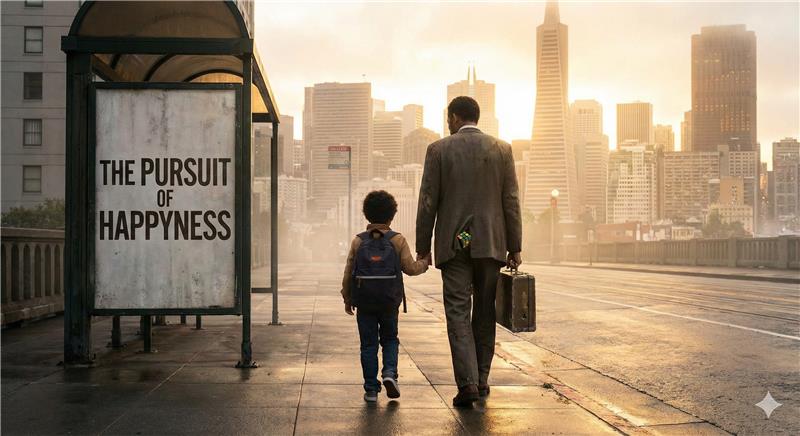
The Pursuit of Happyness is based on the true story of Chris Gardner, who in the early 1980s went from homeless and sleeping in San Francisco subway bathrooms to becoming a multimillionaire stockbroker and, eventually, a successful entrepreneur and motivational speaker. The film opens with Chris struggling to sell portable bone density scanners, medical equipment that is expensive, slightly obsolete, and nearly impossible to move. His investment in scanner inventory has drained his savings, putting immense strain on his marriage. His wife Linda works double shifts, yet they can't pay rent. She eventually leaves, moving to New York and leaving Chris with full custody of their five-year-old son, Christopher. Chris's break comes when he meets a stockbroker and learns about the Dean Witter training program—a six-month unpaid internship where twenty candidates compete for one paid position. Despite having no finance background, no college degree, and the responsibility of raising his son alone, Chris talks his way into the program by solving a Rubik's Cube in a cab ride with the department head. What follows is a brutal six months: Chris is evicted from his apartment and becomes homeless. He and Christopher sleep in subway bathrooms, homeless shelters, and occasionally his office when he can sneak in. Chris hides his homelessness from colleagues and supervisors, maintaining professional appearance and performance while his world crumbles. He spends evenings lining up for shelter beds, then studying investment manuals after Christopher falls asleep. The film's emotional core isn't Chris's eventual success but the daily indignities he endures while maintaining hope: being arrested for unpaid parking tickets the day before his internship interview, arriving at the interview in paint-covered clothes, standing in shelter lines with his young son, teaching Christopher that the "game" they're playing (sleeping in public bathrooms) is an adventure. The most devastating scene shows Chris breaking down in a locked bathroom, holding his sleeping son, having reached absolute bottom.
Remember the Titans
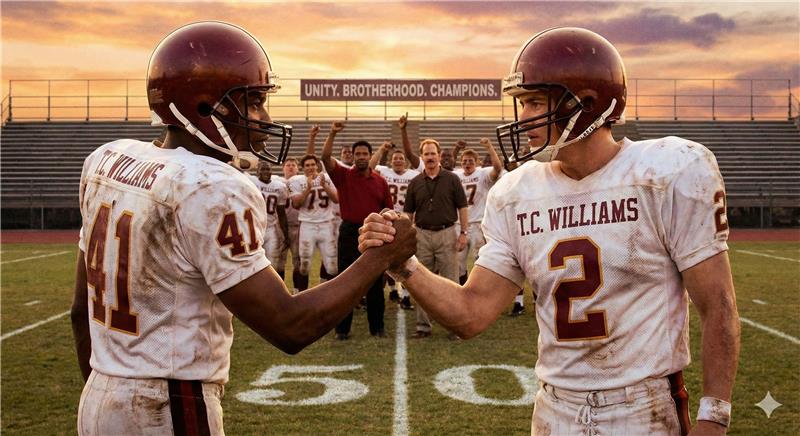
Remember the Titans is based on the true story of the 1971 T.C. Williams High School football team in Alexandria, Virginia, during the first year of court-ordered school integration. The film captures a moment when America's racial wounds were raw—the Civil Rights Act was only seven years old, and many communities violently resisted integration. The story begins in summer 1971 when Alexandria's school board merges three high schools (one predominantly Black, two white) into T.C. Williams. The community is bitterly divided: white parents protest integration, Black students face hostility and violence, and racial tensions threaten to explode. The school board makes a controversial decision: hire Herman Boone, a successful Black coach from North Carolina, as head football coach. This displaces Bill Yoast, the beloved white coach who had been promised the position and whose teams won multiple championships. Yoast initially plans to resign in protest, but his players beg him to stay as defensive coordinator—they need him, and they fear Boone's discipline. Yoast agrees to stay, creating an uneasy partnership between the two coaches who represent their divided community. Pre-season training camp at Gettysburg College becomes the crucible for transformation. Boone deliberately creates extreme conditions: three-a-day practices in August heat, runs up steep hills at dawn, brutal physical conditioning. More controversially, he forces racial integration: Black and white players must room together, learn each other's backgrounds, and support each other or face severe consequences. When white players stage a protest refusing to play with Black teammates, Boone threatens to cut anyone who doesn't commit fully. When fights break out, he makes the entire team run until dawn. The tension explodes in a midnight confrontation. Gerry Bertier, the white captain, and Julius Campbell nearly come to blows over a practice mistake. Boone forces them to get to know each other during early morning runs, pairing every white player with a Black partner. He takes them to the Gettysburg battlefield—site of the Civil War's bloodiest battle—and delivers a speech: "Fifty thousand men died right here on this field, fighting the same fight that we are still fighting among ourselves today... You listen, and you take a lesson from the dead. If we don't come together right now on this hallowed ground, we too will be destroyed, just like they were."
Schindlers List
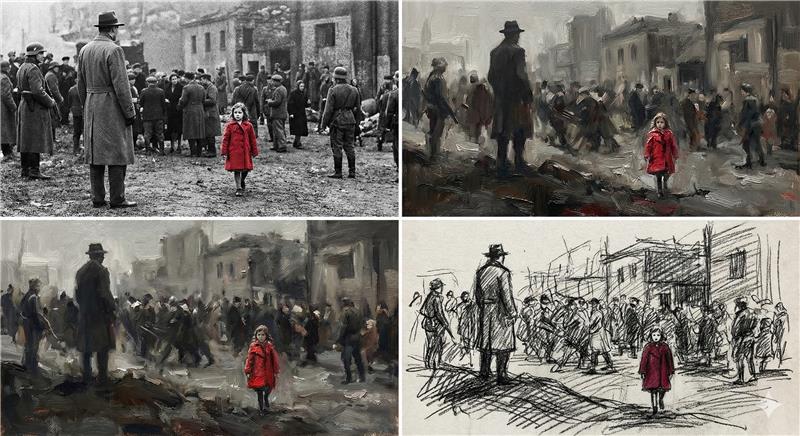
Schindler's List is based on the true story of Oskar Schindler, a Czech-German industrialist who saved approximately 1,200 Jews during the Holocaust. Set primarily between 1939 and 1945, the film follows Schindler's transformation from opportunistic war profiteer to heroic savior. When the film opens, Schindler is a bon vivant, a member of the Nazi party seeking to profit from World War II by opening an enamelware factory in Krakow, Poland. He's charismatic, amoral, and greedy, hardly hero material. He employs Jewish workers because they're cheap labor, not from any humanitarian impulse. The turning point comes when Schindler witnesses the liquidation of the Krakow ghetto in March 1943. From a hilltop overlooking the carnage, he watches Nazi soldiers systematically murder Jewish families in the streets. A little girl in a red coat (the only color in the black-and-white film) wanders through the chaos, a symbol of innocence amid horror. This moment shatters Schindler's moral indifference, he can no longer pretend not to see what's happening. Schindler begins using his factory as a refuge, employing as many Jews as possible and claiming they're "essential workers" for the German war effort. When the Płaszów labor camp is liquidated and workers are scheduled for transport to Auschwitz death camp, Schindler bribes Nazi officials and compiles his famous "list", 1,100 names of workers he claims to need for a new factory. He spends his entire fortune on bribes and black market supplies to keep his workers alive.

Coach Carter
Coach Carter is based on the true story of Ken Carter, who in 1999 coached the Richmond High School Oilers basketball team in Richmond, California. Richmond is an economically depressed area with high crime rates, where many young men face limited opportunities and shortened life expectancies. The school's graduation rate hovers around 50%, and even fewer students go to college. Carter, who played basketball at Richmond High in his youth before becoming a successful sporting goods entrepreneur, agrees to coach the team for minimal pay. He immediately implements radical changes: players must sign contracts committing to maintain 2.3 GPAs, attend all classes, sit in the front row, wear dress shirts and ties on game days, and address coaches and teachers as "sir" or "ma'am." The undefeated team's attitude is initially dismissive—they want to focus on basketball, which they see as their only path out of poverty. The turning point comes midseason when Carter checks academic progress and discovers most players are failing classes despite earlier promises. His response is unprecedented: he locks the gymnasium, cancels games, and forces players to study in the library until they meet academic standards. The "lockout" triggers massive controversy—parents, community members, and even the school board demand he reopen the gym. A contentious community meeting results in a vote to override Carter's decision. Carter arrives at the gym to find it padlocked per the board's order—but then discovers his players have brought their books and are studying in the bleachers, having chosen academics over basketball. This moment represents the culmination of Carter's leadership: he didn't just teach basketball; he transformed his players' understanding of their own potential and worth.

Dead Poets Society
Dead Poets Society is set in 1959 at Welton Academy, an elite all-boys preparatory school in Vermont. Welton is defined by its "Four Pillars"—Tradition, Honor, Discipline, Excellence—and its singular purpose: preparing wealthy boys for Ivy League universities through rigorous, conformist education. Students call it "Hellton" because of its oppressive atmosphere where creativity, emotion, and individuality are systematically suppressed in favor of obedience and academic achievement. The film opens with the start of the school year. Among the new students is Todd Anderson, younger brother of a Welton valedictorian, burdened by impossible expectations. Returning students include Neil Perry, a talented, charismatic young man whose authoritarian father controls every aspect of his life, dictating that Neil will become a doctor regardless of Neil's passion for theater and poetry. Into this rigid environment comes John Keating, a Welton alumnus returning as English teacher after years at a progressive London school. From his first class, Keating disrupts norms: he has students rip out the introduction to their poetry textbook (which attempts to scientifically "graph" a poem's greatness), he makes them stand on desks to see the world from new perspectives, he takes them to the school's trophy hall to hear whispers from the dead: "Carpe diem—seize the day, boys. Make your lives extraordinary." Keating's pedagogy is Socratic and experiential. He doesn't lecture at students—he provokes them to think, feel, and discover for themselves. He teaches that poetry isn't about analyzing meter and rhyme schemes; it's about passion, beauty, rebellion, and truth. He quotes Whitman: "We don't read and write poetry because it's cute. We read and write poetry because we are members of the human race, and the human race is filled with passion." Inspired by discovering that Keating was part of a secret "Dead Poets Society" as a student, Neil revives the group. Students sneak out at night to a cave where they read poetry, share original work, and explore ideas forbidden at Welton—romance, rebellion, questioning authority, pursuing dreams. These meetings become spaces where they can be authentic selves suppressed by school and family expectations.
The Kings Speech
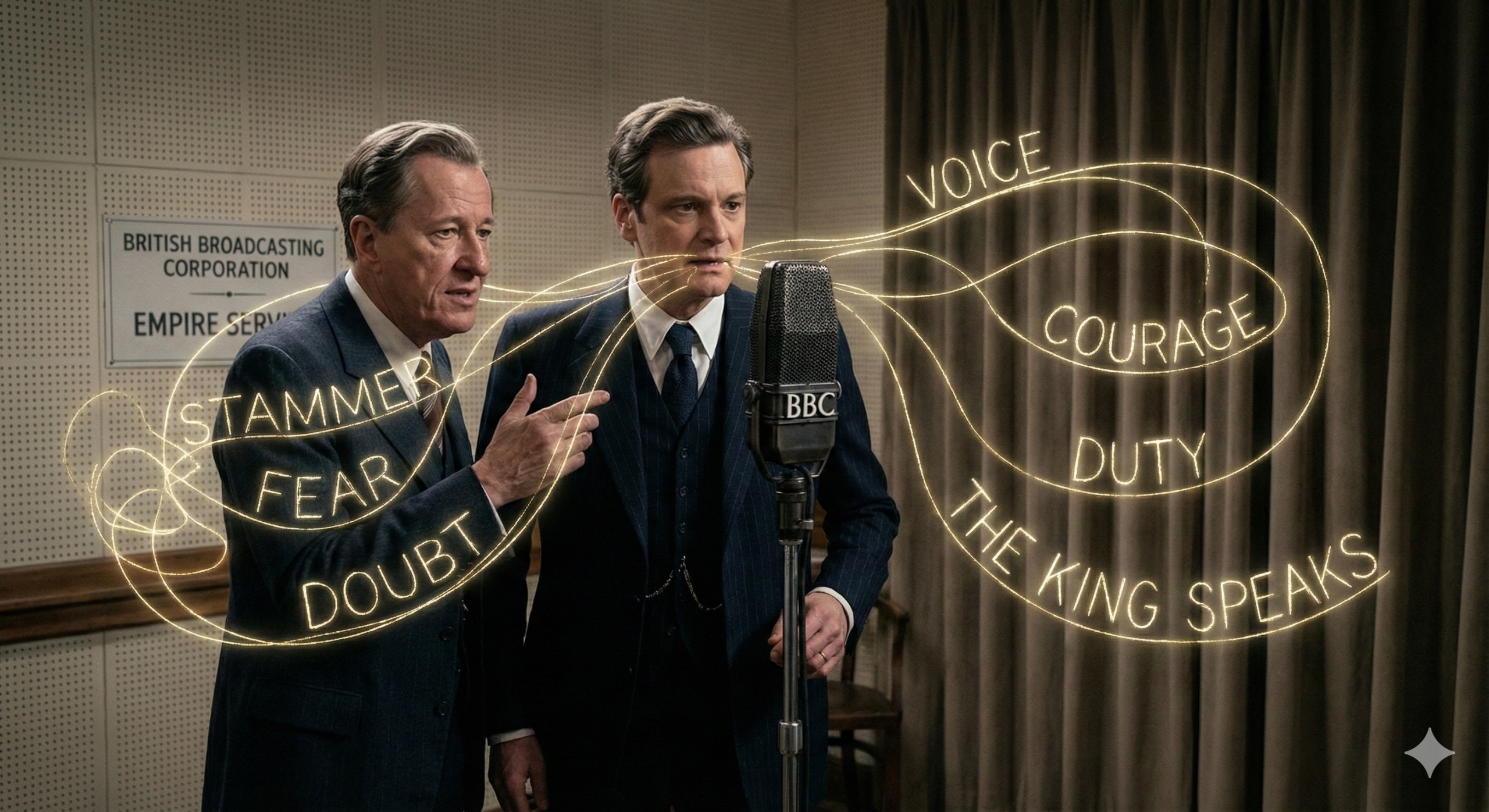
The King's Speech is based on the true story of King George VI (born Albert, called "Bertie" by family), who ruled Britain from 1936-1952, including through World War II. The film focuses on the years 1925-1939, chronicling Bertie's struggle to overcome a debilitating stammer that makes public speaking—essential to monarchy—nearly impossible. The film opens with Bertie attempting to deliver a speech at the British Empire Exhibition in 1925. Before 100,000 people and radio listeners worldwide, he freezes, stammers painfully, and endures excruciating silence. The trauma deepens his anxiety about public speaking, creating a vicious cycle: fear of stammering causes stammering, which increases fear. Bertie has tried every medical treatment available—tongue exercises, mouth devices, smoking (supposed to relax the throat)—all failures. His wife Elizabeth, desperate to help, secretly finds Lionel Logue, an Australian speech therapist with unconventional methods and no formal medical credentials. Logue operates from a shabby London office, treating mostly shell-shocked WWI veterans. His approach focuses on psychological causes of speech impediments rather than purely mechanical solutions. Their first meeting is contentious: Logue insists on calling Bertie by his first name (shocking breach of royal protocol), conducts therapy on equal footing rather than deferentially, and proposes unorthodox methods including swearing, rolling on floors, and discussing childhood trauma. Bertie, proud and defensive, nearly walks out. But Logue bets he can make Bertie read Shakespeare flawlessly—he has Bertie read "To be or not to be" while wearing headphones playing loud music (so Bertie can't hear himself). When Logue plays back the recording, Bertie hears himself reading perfectly. This proves that Bertie's stammer isn't physical inability but psychological block.
Lean on Me
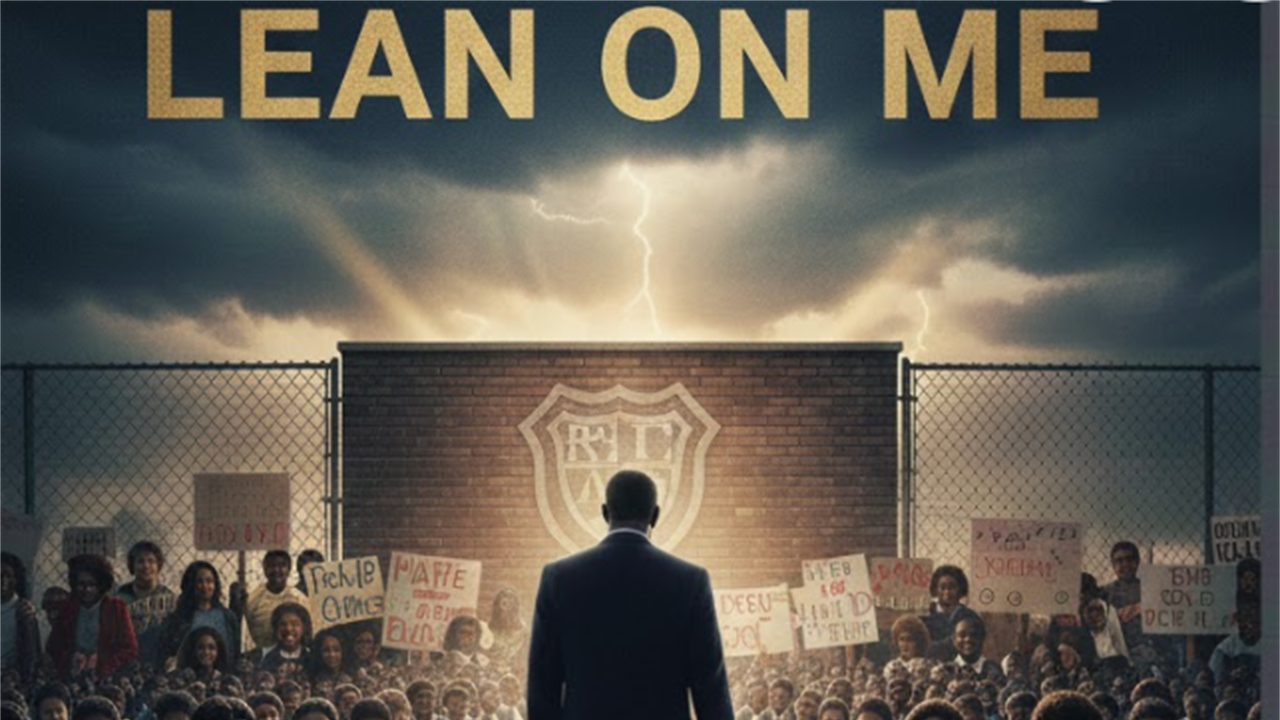
Lean on Me is based on the true story of Joe Clark, who in 1982 became principal of Eastside High School in Paterson, New Jersey—a school that had deteriorated from a proud institution into a dangerous failure. The real Joe Clark was a controversial figure whose methods sparked national debate about education reform, discipline, and leadership in urban schools. The film opens with a flashback to 1967 when Eastside High was an orderly, successful school where Joe Clark taught. He's an idealistic young teacher advocating for high standards and discipline. But the district transfers him to an elementary school, and over the next 15 years, Eastside collapses: gangs take over hallways, drug dealers operate openly, violence is routine, academic performance plummets, and the school becomes known as a "cesspool." The state threatens to take over if test scores don't improve dramatically. Superintendent Dr. Frank Napier, desperate to save the school, brings Joe Clark back as principal. Clark has become harder, more cynical, but still believes excellence is possible. He accepts the job with one condition: complete authority to do whatever's necessary. Napier agrees, knowing Clark's methods will be controversial but believing nothing less extreme can save the school. Clark's first actions shock everyone. He arrives with a bullhorn and a baseball bat (his signature props throughout the film), immediately expelling 300 students in a mass assembly—calling them "drug dealers, drug users, and thugs" who are destroying education for everyone else. He chains the school doors shut from inside (creating fire code violations) to keep drug dealers and gang members out. He patrols hallways confronting students and teachers, demanding excellence, and tolerating no excuses. His methods are authoritarian: he fires teachers he deems incompetent, humiliates students publicly when they fail to meet standards, imposes strict dress codes and behavior rules, and rules through fear and force of personality. The school transforms—hallways become safe, academic standards rise, and students begin believing they can succeed. But the costs are severe: expelled students have nowhere to go, chained doors create safety hazards, parents and civil rights advocates accuse him of racism and cruelty, and the school board moves to fire him.
The Darkest Hour
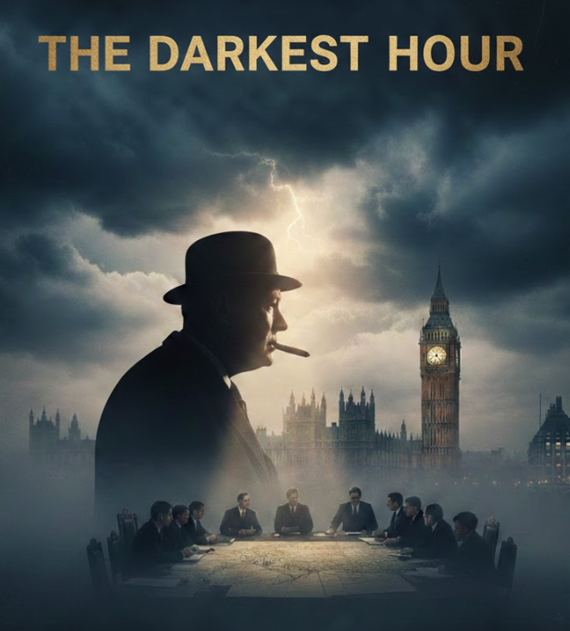
Darkest Hour focuses on a critical 26-day period in May 1940 when Winston Churchill becomes Prime Minister just as Nazi Germany launches blitzkrieg through Western Europe. The film opens with Britain's situation appearing hopeless: France is collapsing, Belgium has surrendered, 300,000 British troops are trapped at Dunkirk facing annihilation, and Hitler's forces seem unstoppable. Churchill is appointed Prime Minister not because he's beloved—he's not—but because no one else will take the job at this desperate moment. His political career has been marked by failures: the disastrous Gallipoli campaign in WWI (which he championed), years in the political wilderness, and reputation as a warmonger. King George VI actively opposes his appointment, preferring the more diplomatic Lord Halifax. The Conservative Party, which Churchill nominally leads, doesn't trust him. Even his own family questions whether he's up to the task—he's 65, drinks heavily, suffers from depression (his "black dog"), and has a volcanic temper. When Churchill takes office on May 10, 1940, the same day Germany invades France, he faces multiple catastrophic scenarios: Britain lacks the military strength to fight Germany alone; the British Expeditionary Force at Dunkirk faces total destruction; America refuses to enter the war; and public opinion, exhausted from WWI, favors negotiated peace. His War Cabinet, including Halifax and Chamberlain, push for negotiations with Hitler through Italian intermediary Mussolini, arguing that Britain cannot win and must secure the best terms possible before total defeat. Churchill rejects this consensus. He believes negotiating with Hitler means slavery, that Hitler will honor no agreement, and that Britain must fight regardless of odds. But he cannot simply decree this—he needs War Cabinet support and must carry public opinion. The film follows Churchill wrestling with terrible isolation: nearly everyone he trusts—advisors, Cabinet members, military leaders, even the King—believes he's leading Britain to destruction through stubborn refusal to face reality.
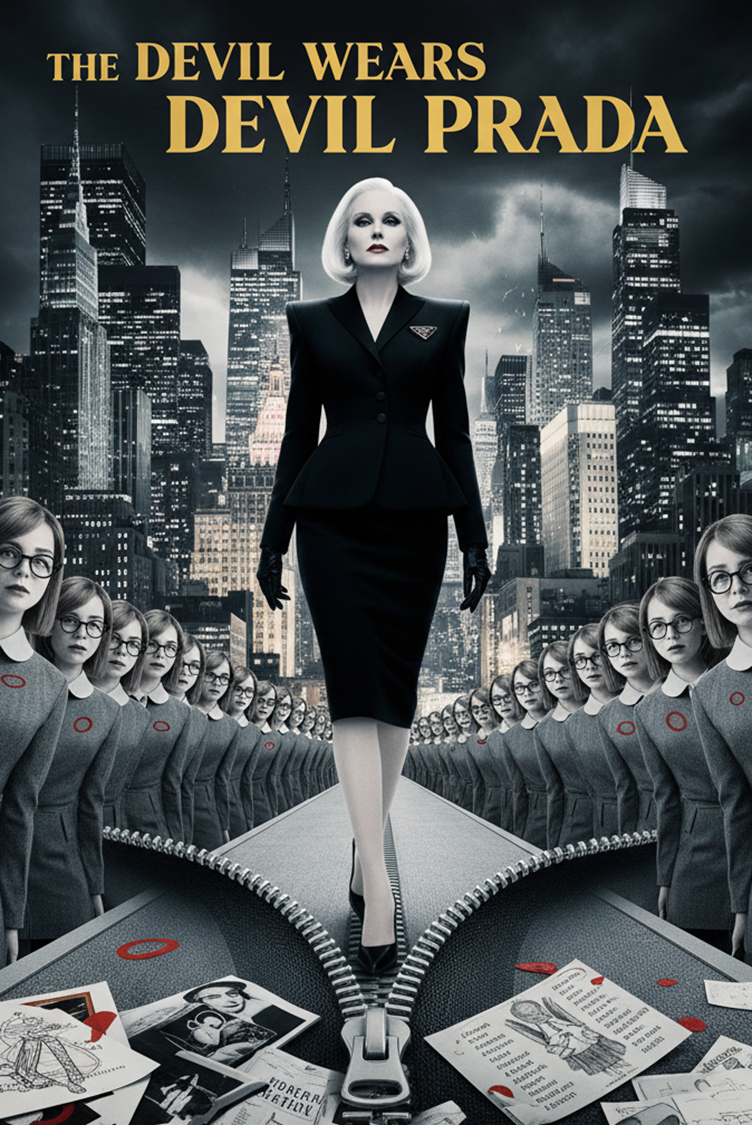
The Devil Wears Prada
The Devil Wears Prada is based on Lauren Weisberger's roman à clef about working for Anna Wintour, legendary Vogue editor. The film is set in the high-stakes world of fashion publishing in New York City, where Runway magazine is the most influential publication in the industry and Miranda Priestly is the most powerful woman in fashion. Andy Sachs arrives at Runway with journalism dreams and complete ignorance about fashion. She views the magazine world as frivolous—a temporary stepping stone to "serious" journalism at places like The New Yorker. She applies to be Miranda's assistant purely for resume credentials, believing "a year of that will open any door." Andy doesn't know that this job—which millions would kill for—is notorious for destroying assistants. Previous assistants have quit mid-shift, suffered breakdowns, or been fired for minor infractions. Miranda Priestly is fashion royalty—her opinions make or break designers, her magazine sets global trends, and her approval is the industry's gold standard. She's also terrifying: she speaks in quiet, icy tones, her requests are impossible demands delivered as mild suggestions, and she shows no patience for incompetence or personal problems. Her assistants exist solely to anticipate and fulfill her every need, professional and personal, regardless of hour or reasonableness. Andy initially performs poorly—she's unfashionable (offense in fashion world), doesn't understand industry dynamics, and treats tasks as beneath her. After being humiliated by Miranda and Emily, Andy has a choice: quit like previous assistants or commit fully. Nigel, the creative director, delivers the wake-up call: "Wake up, Six! She's just doing her job. Don't you know that you are working at the place that published some of the greatest artists of the century?... So you think this has nothing to do with you. You go to your closet and you select that lumpy blue sweater, for instance, because you're trying to tell the world that you take yourself too seriously to care about what you put on your back... However, that blue represents millions of dollars and countless jobs, and it's sort of comical how you think you've made a choice that exempts you from the fashion industry when, in fact, you're wearing a sweater that was selected for you by the people in this room." Andy commits. She transforms her appearance, masters the job's impossible demands (including the famous "Harry Potter manuscript" task—obtaining the unpublished final book for Miranda's daughters), and becomes indispensable. Success costs her: her boyfriend Nate resents her unavailability, her friends mock her superficiality, and she misses a birthday party due to work. But Andy experiences the seductive pull of excellence—she's good at this, Miranda increasingly relies on her, and the fashion world that seemed frivolous reveals itself as creative, influential, and intoxicating.
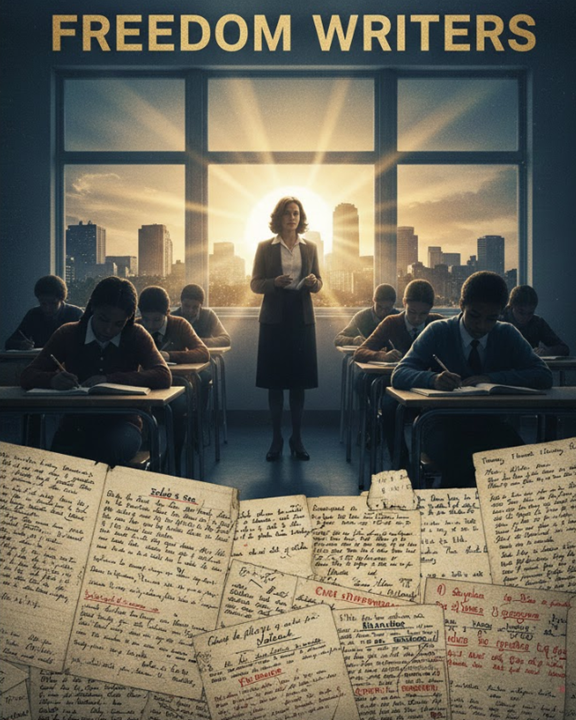
The Freedom Writers
Freedom Writers is based on the true story of Erin Gruwell, who taught English at Woodrow Wilson High School in Long Beach, California, starting in 1994, two years after the Los Angeles riots following the Rodney King verdict. The school, once high-performing and predominantly white, has become majority Black, Latino, and Asian due to mandatory integration policies. Long Beach is experiencing gang violence, racial tensions, and poverty. Most students come from broken homes, have witnessed murders, and see education as irrelevant to survival. The film opens with Erin Gruwell's first day teaching—she's idealistic, well-meaning, and completely unprepared for the reality. Her classroom is filled with students from rival gangs sitting in self-segregated racial groups: Latinos, African Americans, Cambodian refugees, and a few white students. They've been labeled "unteachable" by the school system—placed in Room 203 as a holding pen until they drop out or get incarcerated. Previous teachers have given up on them. The students have given up on themselves. Erin's initial attempts at teaching are disasters. She tries to discuss Homer's Odyssey with students who can barely read, who don't see how ancient Greece connects to their gang-war realities, and who mock her as a naive white woman playing savior. The department head, Margaret Campbell, refuses to give Erin new books ("They'll just draw on them or sell them"), expecting her to fail and quit like previous teachers. The turning point comes when Erin intercepts a racist drawing one student made mocking another's appearance. She explodes, asking how many students know what the Holocaust was. Almost no one raises their hands. Erin makes a connection: "The Holocaust was about ethnic cleansing. About hatred for people different from you. How many of you have been shot at because of your race? How many of you have lost friends to gang violence?" Every hand goes up. Suddenly, the students see that historical atrocities connect to their lived experience—they're experiencing their own ethnic cleansing in gang wars. Erin radically changes her approach. She abandons the prescribed curriculum, instead teaching through texts her students can relate to: The Diary of Anne Frank (teenager hiding from persecution), The Diary of Latasha Harlins (15-year-old shot in LA riots), and gang literature. She gives students journals to write their own stories, promising confidentiality. She creates experiences that expand their worldview: inviting Holocaust survivors to speak, taking them to the Museum of Tolerance, organizing a "Toast for Change" dinner where students honor those who've helped them survive.